


It has been a long time since the COVID-19 pandemic ended and our lives returned to normal. Of course, its memories still linger in people’s minds. During the lockdown, schools were closed. Children were deprived of studies, reading, and the company of their friends. At such a time, many teachers implemented various initiatives at their own level. Baswant Vithabai Babarao is not a teacher in the conventional sense. However, during the pandemic, he implemented the ‘Anandshala’ (Joyful School) initiative for children in his village. About 25-30 children regularly attended Anandshala. We are bringing the stories that blossomed from this Anandshala to the readers of Palakneeti throughout this year. The seeds of these stories and many of the incidents are real, while some incidents are fictional.
Mahadu hadn’t been seen at school for the past two days.
On the third day, his sister Pooja came.
I asked her, “Why isn’t Mahadu coming to school?”
Pooja hesitated a little. Then she quietly said, “Sir, he couldn’t solve the math problem you gave him. That’s why he’s not coming.”
“But if he doesn’t come to school, how will he learn math?”
As soon as I asked, Pooja looked down and said, “No, sir… but the other children laugh at him. That’s why he’s not coming.”
I sent a message to Mahadu through Pooja, asking him to come to school, but even after a week passed, Mahadu didn’t come.
It was the time of the lockdown. Schools were closed, but the children in the village continued to wander, play, and roam around in groups. Our little Anandshala had started with the idea that we could gather the children for two or three hours in the evening and teach them something.
That Friday, before school ended, I said to the children, “There is an important announcement for tomorrow.”
The children looked on with curiosity. Someone whispered, “Give us some fun homework, sir!”
I smiled.
“There’s no homework tomorrow. Tomorrow is Saturday, the day after is Sunday. And on Sunday… we are going on a field trip.”
The class erupted in excitement.
“Oh… a field trip! So much fun!”
I continued, “Tomorrow, bring two handfuls of rice and one handful of lentils.
Any type of lentils will do, and any type of rice will also be fine.”
A field trip meant cooking together in the fields… making leaf plates from Palash leaves… preparing spiced rice with tubers and vegetables found in the fields… and eating while sitting under a tamarind tree… the children knew all this.
Then I deliberately said, “Pass this message on to those who are absent today.”
As school ended, we would recite the prayer, ‘The only true religion is…’
That day’s prayer was recited with extraordinary enthusiasm. After the prayer, the children ran home, jumping with joy.
That same evening, Mahadu came to me hesitantly.
Mahadu always used to talk about unrelated things first and then reveal the important matter at the end. That was his habit.
First, he talked about his buffalo. What kind of fodder was good for her… the grass he got from weeding, Marvell grass, Kena grass… where and how he got the grass… in whose field weeding was going on… how lush green grass had grown in someone’s field because of the well water…
After telling all this, he quietly said, “Sir, I heard you are taking us on a field trip. It would be good if you took the trip towards Gantawar’s field. There’s a stream there, and you can see different kinds of trees…”
After all the preamble, he finally came to the point, “Sir, will it be alright if I come on the field trip?”
I deliberately took a negative stance. “Didn’t we decide that those who hadn’t attended school for a week wouldn’t be taken on the field trip?”
He immediately replied,
“Yes sir… but please let me come this time. I won’t skip school after this.”
Mahadu was behind in reading and writing. He dreaded math class and his math notebook; however, he was the best when it came to practical calculations.
Agricultural wages, weeding, and the amount of seed required per acre for sowing…
He knew it all by heart.
Finally, Mahadu managed to get permission to participate in the field trip.
He left for home in a completely different mood.
On the day of the field trip, the whole scene changed.
As soon as they left the village and entered the fields, Mahadu’s confidence grew.
Which leaves were edible, which were not… where to find which vegetable… he was enthusiastically sharing information with everyone.
There were custard apple trees. Underneath them, the Lantana plant was spread out. In between, there were ‘Tarwad’ bushes.
Mahadu stopped there.
“Stop here for a moment,” he said casually.
The children, who usually didn’t pay much attention to his instructions at school, stopped immediately, taking his word as law.
A vine was climbing up with the support of the Tarwad, Lantana, and custard apple trees. Mahadu went into the bushes and brought back some tender leaves of the vine.
I felt worried when he went into the bushes.
I went near him and said, “Mahadu, be careful… there might be scorpions and insects down there.”
Before I could finish my sentence, he stopped me and said, “Sir, you stay far away. There are snakes down here.”
Taking the children on a field trip meant that we were responsible for them. During the first few trips, I used to give the children a lot of instructions. But when Mahadu was with us, the difficult spots, the places where we needed to stop and watch carefully, the leaves that caused itching, the vines… everything was taught naturally, as part of the experience. Mahadu’s experience and knowledge of the fields were very useful to us during the field trips.
Mahadu brought a handful of leaves from that vine.
First, he gave two leaves to me.
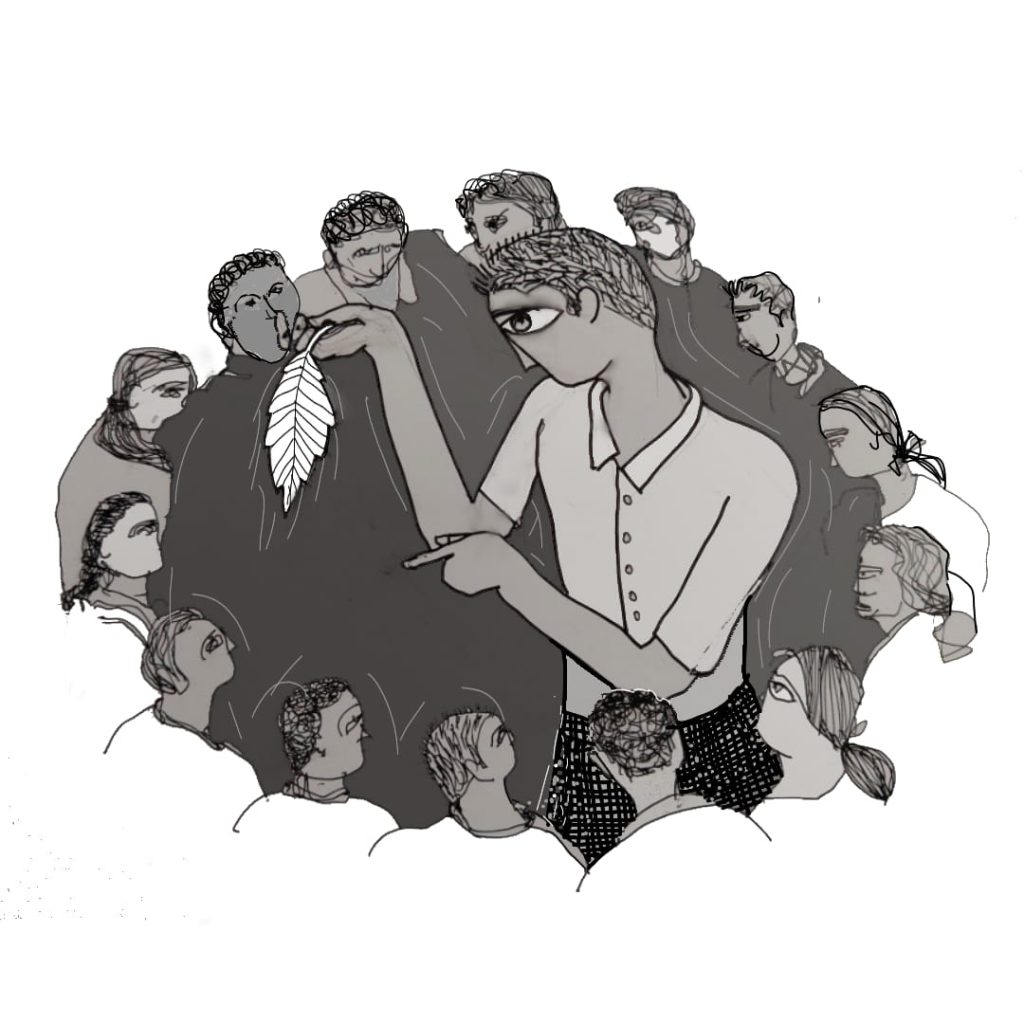
Then, giving one leaf to each of the children, he said, “Taste these leaves.”
We all tasted the leaves.
The taste was unique. The taste lingered in our mouths for quite some time. Everyone liked it.
“What kind of leaves are these?” the children asked in unison.
“These are the leaves of the Fandi plant,” Mahadu began to explain.
“Fandi?”
“Yes, Fandi!”
He continued, “Fandi is the name of this vine. A vegetable is made from these leaves. It’s called Fandi bhaji (Fandi vegetable).”
Just then, Manmath ran towards a bush.
I stopped him.
I said to Mahadu, “Give Manmath some leaves.”
Mahadu gave him the leaves.
This way more leaves were added to Manmath’s collection.
A little further on, at a bend, there was a striking Amaltas tree.
Mahadu stopped. He observed the tree for a while.
He came back holding something closed in his hand… The children gathered around him excitedly. Mahadu gently opened his hands.
A large beetle flew away with a buzzing sound.
“This is a golden beetle,” Mahadu began to explain, “It is always found on the Amaltas tree; it loves to eat the leaves of the Amaltas tree.” The same children who were laughing at Mahadu in the classroom, mocking him for not knowing maths, were now gathered around him, listening to his every word like attentive students.
For our field trip, we headed towards Naghnath Gantawar’s farm. As soon as he saw us, Naghnath came forward.
Untying the towel wrapped around his head, he wiped the sweat from his face and said, “Welcome, teacher. It seems the children have come to see the fields today.”
“Yes,” I said, “Today I want to show them the fields outside of their textbooks.”
Naghnath smiled and said, “Then let’s go towards the river first. You can see different plants and creatures there.”
Just then, his children, Amruta and Anuj, came near us.
“Dad, should I spread the ‘chavale’ (a mat made by stitching together empty sacks) under the tamarind tree?” Amruta asked.
“Spread it. We’ll sit there after we’re done walking around,” Naghnath said.
A little further on, the jowar crop became visible. Mahadu immediately went ahead.
“This jowar has started to develop ears of grain,” he said.
“Jowar doesn’t need much water; it grows well even with just the winter dew.”
Naghnath nodded in agreement.
Just then, Manmath stopped near a bush.
“Sir, look at the back of these leaves,” he said.
There were small knots on the back of some of the leaves.
“I told you about this during the last trip, didn’t I?” he reminded us.
“I had told the children during the last field trip that some trees, like Arjun, Bibba, and Palash (Flame of the Forest), have knots on the back of their leaves.
‘We have to collect these leaves with knots separately.'”
As we reached the riverbank, we started hearing a buzzing sound.
Anuj said, a little frightened, “Father, there are a lot of bees here.”
Nagnath stopped. “Don’t be afraid. Bees are always found near the riverbank to drink water. They don’t bother us, and we shouldn’t bother them.”
Mahadu looked around and said, “When there are bees, the crops also benefit.”
Nagnath looked at me and said, “Teacher, this is the kind of learning the children should get from the fields. This is the real school.”
We walked along the riverbank for some distance.
Some took smooth pebbles from the river, while others built a small house by standing on a sandbar formed by the accumulated sand in the river. Manmath took some shiny pebbles.
Seeing the children enjoying themselves together on the sandbar, Nagnath stepped forward and began recounting his old memories.
“When the river dried up, we used to dig a hole in this sand and drink water.”
Even when the river dries up, there is water inside this sand.
Nagnath was giving a lot of information, such as how such places have become fewer lately because many people have taken this sand for building houses.
One or two children dug a hole to see how water collects in it. The children were having fun.
The sun was starting to get a little stronger.
Now, we slowly started moving towards the tamarind tree.
The field trip concluded under the tamarind tree.
Everyone started describing what they saw, what they ate, and what they learned.
They had noted down even the smallest details in their notebooks. Some had drawn pictures of trees, leaves, bees, and butterflies.
The children were talking enthusiastically.
I deliberately praised Mahadu’s deep knowledge of nature.
I told everyone how important that knowledge was.
After that day, Mahadu started coming to school regularly.
Now he no longer sat timidly in the classroom.
Gradually, his math skills began to improve.
Mahadu, who had blossomed in the fields, slowly began to blossom in school as well.
Original Marathi story : Baswant Vithabai Babarao
English : Arvind Gupta
Illustration : Ramakant Dhanokar